
Soil Thermal & Electrical Resistivity Testing
Australia-wide testing of how soil conducts or resists heat and electrical current — critical data for safe, efficient underground cable design and earthing systems.
Why thermal & electrical resistivity testing matters
Soil thermal resistivity testing measures a soil’s ability to conduct or dissipate heat. Heat is generated whenever electricity passes through underground cable — if it isn’t dissipated efficiently, it can slow current transfer or, at worst, damage the cable. Testing the natural soil and bedding media before cables are laid lets engineers determine the correct cable thickness for the required voltage and amperage.
Where natural soil resistivity is too high, Soiltester can advise on thermal backfill materials placed around the cable to transfer heat more readily. Once a bedding material is selected, its thermal and electrical properties must also be tested so cable design and bedding thickness can be adjusted accordingly.
Soil electrical resistivity testing serves a related but distinct purpose: it measures how strongly soil resists electrical current flow, which directly affects the performance of earthing and grounding systems, required for compliant earthing design in line with utility and Energy Networks Australia requirements.
Full Testing Methodology
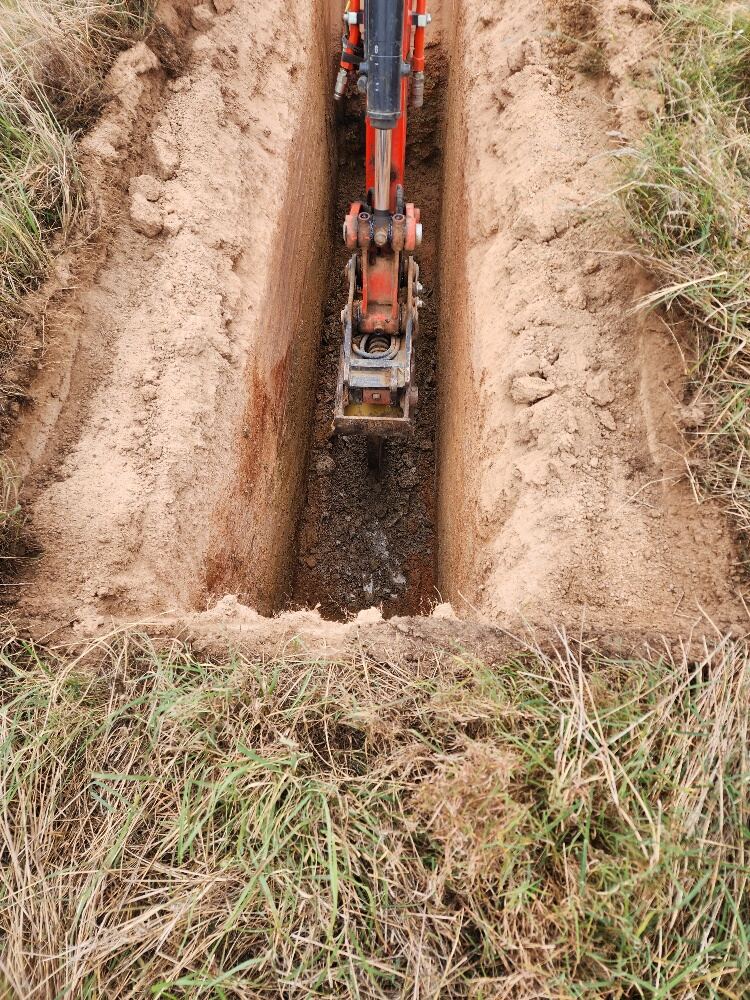
Testing begins on site, using the thermal probe/heater method: a needle probe containing a heating element and temperature sensor is inserted into the undisturbed soil or backfill along the cable route, a controlled heat pulse is applied, and the rate of temperature rise and decay is used to calculate the soil’s thermal resistivity in its as-found (in-situ) condition.
A sample of the same material is then taken back to the laboratory for a second, complementary stage of testing. The sample is progressively dried out and retested at a series of controlled moisture contents, building a resistivity/moisture curve from the fully saturated state through to full dry-out. This identifies the worst-case (driest) resistivity value the material can reach, which is the figure used for conservative cable and earthing design, rather than relying on a single in-situ reading that may not reflect long-term dry-season conditions.
Material Specification
Where a manufactured thermal backfill or bedding material is specified rather than relying on natural soil, Soiltester tests and certifies it against the following criteria:
- ✓ Maximum thermal resistivity of 1.2 K·m/W at full dry-out
- ✓ Resistivity remains stable down to 0.5% moisture content
- ✓ Compacted to a minimum 98% of maximum dry density
- ✓ Screened to a maximum particle size of 4.75mm
- ✓ Tested in accordance with ASTM D5334-08 and IEEE 442
- ✓ Flowable mix designs supplied to a slump of 90–130mm
Test Frequency & Sampling Standards
Sample frequency for thermal backfill supply is set on a tonnage basis and increases with the volume of material delivered to site, in line with AS 1289 (soil testing methods), AS 1141.3.1 (sampling of aggregates) and, on Queensland Government projects, Department of Transport and Main Roads test methods Q050 and Q060. Sample locations are selected at random across each load or stockpile to avoid bias, and the Principal (the client or their engineer) retains the right to direct additional or repeat testing at any point in the programme if results are in question.
Get in touch with your tonnage and programme and we can confirm the exact sampling frequency and reporting schedule for your project.
What's included
- ✓ In-situ thermal needle probe field testing along cable routes or trench locations
- ✓ Dry-out resistivity and in-situ moisture content profiling
- ✓ Electrical resistivity testing for earthing and grounding design
- ✓ Thermal backfill material specification and verification
- ✓ Clear reporting with worst-case values for conservative cable rating
Who this service is for
Consulting engineers, electricity network operators, solar and wind farm developers, and civil contractors planning underground cable routes, substations or switchyards where accurate thermal and electrical soil data is required before design sign-off.
Related questions
What's the difference between soil thermal conductivity and soil electrical resistivity?
Thermal conductivity impacts underground cable ampacity; electrical resistivity affects earthing and grounding system performance. Both are tested for different design purposes.
How does soil moisture affect results?
Moist soil generally has lower thermal resistivity (better heat dissipation) and lower electrical resistivity (better earthing performance). Worst-case dry conditions are used for conservative design.
How is field testing conducted?
A thermal needle probe is inserted into undisturbed soil or in-situ trench locations, applying controlled heat and measuring temperature rise over time, following Australian-adopted testing standards.
Planning an underground cable route or substation?
Get standards-aligned thermal and electrical resistivity data before your design is finalised.